
When Competitive Intelligence Costs $129/Month, What Is Your Strategy Team Actually Doing?
AI-native competitive intelligence tools collapse a week of analyst work into a single report. Here is what enterprise strategy teams should keep, automate, and own in 2026.
The price of knowing what your competitor shipped last quarter just dropped to $29
For most of the last decade, competitive intelligence has been a procurement problem dressed up as a strategy problem. The serious tools — Crayon, Klue, Kompyte — list at $129 to $1,500 per month, with implementation cycles that run a quarter and a change-management budget to match. The honest ones, like SimilarWeb and SEMrush, charge per seat and punish you for sharing the output.
A new generation of AI-native tools is rewriting that math. Analook, a one-click competitive report launched this month, runs fifteen data sources — DataForSEO for keyword and traffic estimates, social presence across Twitter, GitHub, Reddit and YouTube, Product Hunt launch history, Google Trends peaks, Wayback Machine positioning, pricing structure, and an AI verdict on growth pattern — and assembles the whole package in under a minute. The free tier produces two reports a month with no card. Pro is twenty-nine dollars for thirty reports. It also runs as a remote MCP server inside Claude Desktop and Cursor, which means your strategy lead can request a competitive scan from inside the tool she is already writing the memo in.
What changed, and why enterprise strategy teams should care
The story is not really about price. It is about latency. A traditional CI cycle — analyst scopes the question, pulls data from five tools, formats the deck, sends it for review — takes between five and fifteen business days. By the time the report lands, the pricing change you were tracking has been copied by two of your competitors and matched by a fourth. The intelligence is technically correct and operationally useless.
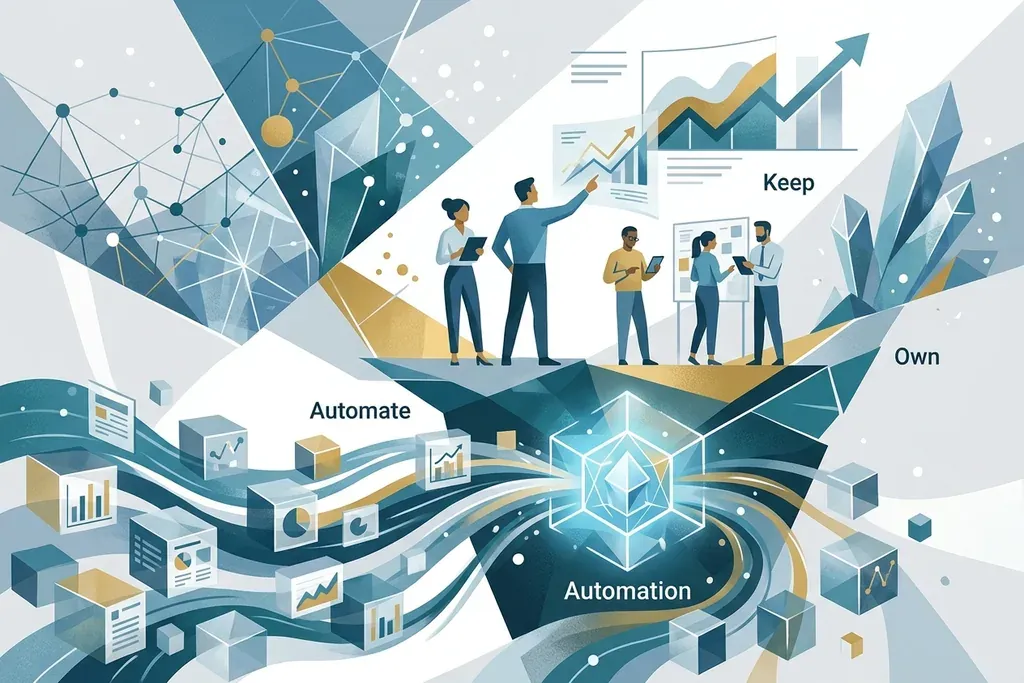
AI-native CI collapses that latency to the time it takes to type a URL. The implication for enterprise strategy is not that you replace your analysts — it is that you move them up the stack. The analysts stop pulling data and start framing the questions. The strategy lead stops formatting decks and starts deciding which competitive moves warrant a real response. The executive sponsor stops reading monthly retrospectives and starts reviewing weekly signals.
A practical framework for adopting AI-native CI inside an enterprise
If you are leading strategy, product marketing, or competitive response at a mid-to-large enterprise, here is the rollout sequence that has held up across the half dozen deployments we have supported this year.
1. Pick one workflow with a known answer first. Run the AI tool against a competitor you already track closely. Validate the output against your existing CI source. The point is not to confirm what you already know — it is to build trust in what you do not. If the tool misses a positioning shift your analyst caught three weeks ago, you know where its blind spot lives.
2. Move weekly scans upstream of the analyst. Hand the tool to a senior analyst or strategy associate as an automation, not a research project. Their job becomes reviewing and editing, not gathering. Expect to cut the time spent on data assembly by seventy to eighty percent inside a month.
3. Keep the human verdict in your process. The AI verdict — the strategic summary at the end of a report — is the single most useful output and the one most likely to mislead. Use it as a draft the analyst edits, not a final answer. The model is good at pattern-matching across data points, weak on reading a board's appetite for a specific fight.
4. Decide which outputs to keep in-house. AI-native CI tools are excellent at pulling public signals. They are not a substitute for primary customer research, win-loss interviews, or channel checks. Make the boundary explicit: the tool owns the outside, your team owns the inside.
The governance questions that come up on day one
Every enterprise strategy lead we have worked with this quarter has asked the same three questions about AI-native CI, in this order.
Where does the data go? Reputable AI-native CI tools call public APIs and do not store the inputs beyond the lifetime of the report. Read the data processing addendum. If a tool will not give you a DPA, do not put your strategic intent into it.
What about hallucinations? Same answer as for any AI tool — keep a human in the loop on the final verdict, treat the underlying data as draft, and do not let an automated report reach an executive without an analyst's sign-off. The risk of a confidently wrong verdict is the single biggest reason mature CI teams still keep an analyst in the chain.
How does this change the budget case? The honest budget case is not that AI-native CI replaces your existing spend. It replaces the marginal report. If your team currently runs twenty competitive scans a year at a fully-loaded cost of eight hundred dollars each, the AI tool pays for itself at three reports a month and frees your analyst for the deeper work that the tool cannot do.
Where this lands inside an enterprise AI roadmap
AI-native competitive intelligence sits in a small but growing category of tools that change the economics of an analyst function rather than replacing it. Pricing intelligence, talent signal monitoring, regulatory horizon scanning — each of these has followed the same pattern over the last eighteen months. A traditional enterprise procurement process that used to take a quarter now takes a credit-card decision. The work that used to take a team of three now takes a team of one plus a tool.
For an enterprise AI strategy that is more than a slide deck, the question is not whether to adopt AI-native CI. The question is which of the other analyst workflows you operate today are ready for the same shape of tool, and what your team will do with the time that comes back. The teams that answer that question well are the ones that turn a procurement problem back into a strategy problem.
Book a strategy consultation to map your analyst workflows against the AI-native tools now viable in 2026.