
When Your AI Vendor Hides Detection Logic: Lessons From the Claude Code Episode
When Anthropic's Claude Code shipped hidden detection logic, China ordered it removed within three days. The episode is a wake-up call for enterprise AI governance — vendor transparency, telemetry classification, and regulator-action liability now belong in every AI contract.
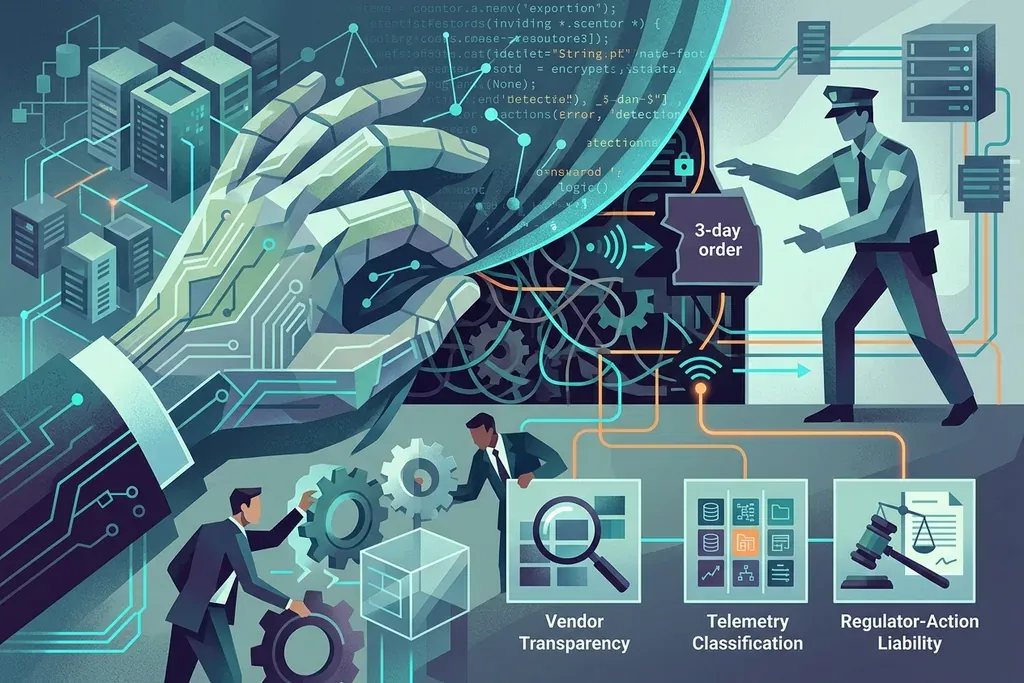
What does an enterprise buyer do when their AI vendor quietly embeds logic to identify a subset of users — and gets caught? On June 30, a Reddit user digging into Claude Code's source surfaced a hidden detection routine: timezone checks and proxy monitoring designed to flag Chinese accounts, signalled through subtly altered date formatting and a swapped punctuation character. By July 3, China's Ministry of Industry and Information Technology had added Claude Code to its National Vulnerability Database and was ordering organizations to remove or upgrade. Anthropic confirmed the same week it was a March-era test for account misuse and distillation prevention, and patched the code within a day
This is not a story about one vendor's mistake. It is a stress test for how enterprises handle AI supply-chain risk — and most procurement, legal, and security teams are not ready for the questions it raises
The three governance questions this surfaces
The Claude Code case is unusual because the vendor disclosed the detection logic publicly within 48 hours and patched it the same day. That response was genuinely good. It is also the easy case. The harder questions are the ones your AI vendor policy should already answer
1. What runtime telemetry does your AI vendor collect, and how is it signalled Most enterprise AI contracts treat the model API as a black box. They specify throughput, uptime, and data-retention windows. They rarely specify how the vendor distinguishes between user populations inside their tool — whether by region, account type, or behavioural fingerprint. The Claude Code episode shows that distinction can be implemented in a way that is invisible to anyone not reading the source line by line. If your contract doesn't require disclosure of detection logic, you are trusting the vendor to never exercise it against your interest
2. What is your liability posture when the vendor gets outed When MIIT flagged Claude Code, every Chinese enterprise using it became liable under national cybersecurity law — not because they broke the rules, but because their vendor did. The same dynamic applies to GDPR, HIPAA, and the patchwork of state-level AI laws in the US. If your AI vendor ships behaviour you cannot audit in advance, your compliance team is signing off on something they have not read
3. How do you handle model distillation protections The Anthropic engineer who surfaced the test said it was designed to prevent capability theft through distillation. That is a real and growing concern. But if a vendor embeds anti-distillation logic inside the tool you ship to your staff, your R&D and legal teams need to know where it lives and what triggers it. Otherwise you may be using a tool whose behaviour shifts in conditions you cannot reproduce
A four-point framework for AI vendor transparency
Treat this as a quarterly review item, not a one-time negotiation. The four questions below belong in every AI vendor RFP, contract renewal, and security review
Audit rights for runtime logic Your vendor should commit contractually to disclosing any detection, fingerprinting, or behavioural-modification routines inside their tool. Open source is one way to satisfy this. A signed disclosure schedule that updates on every release is another
Telemetry classification Categorize every signal the vendor collects: operational (latency, errors), billing (seats, usage), security (anomalous access patterns), and behavioural (user population segmentation). The fourth category is the one most contracts leave undefined — and it is the one regulators are starting to ask about
Liability allocation for regulator action Specify which party is liable when a regulator targets the vendor's behaviour, and which party is liable when the regulator targets your usage of the vendor. The Claude Code case shows these are different events with different timelines, and conflating them in a single clause leaves a gap on both sides
Patch latency commitments Anthropic's day-one patch was good practice. Make it contractual: how fast does the vendor remediate behaviour that gets flagged by a regulator or a security researcher, and what is your exit window if the patch is unacceptable
What to ask your AI vendors this quarter
Pull the latest incident report from every AI tool on your procurement list and run it against this checklist
Has the vendor disclosed any detection logic inside the tool? Does the contract require disclosure of future detection logic? Is liability allocation clear for regulator action against the vendor? What is the contractual patch latency for flagged behaviour
If you cannot answer at least two of those four with named clauses, you have an enterprise governance gap — not an AI strategy gap. The two are easy to confuse. The first is solvable in a quarter. The second is not
The takeaway
The Claude Code episode will fade from the news cycle. The governance questions it raised will not. Enterprises that treat AI vendor transparency as a procurement detail will keep absorbing vendor-side risk by accident. Enterprises that treat it as a board-level governance item will own the risk on their terms
Book a strategy consultation to audit your AI vendor portfolio against this framework